
The Moment You Notice Something's Wrong
You hit the remote on your way out, watch the door roll down, and then it stops a foot from the floor and climbs right back up. Or maybe it won't even start the trip — you press the button and nothing happens, or it goes up a few inches and halts. Either way, you're left standing in the driveway wondering if this is a quick fix or the start of an expensive repair.
The good news is that a door that reverses or refuses to close almost always has one of a short list of causes, and most of them are things a technician checks in a predictable order, starting with the simplest and cheapest to rule out.
What the Behavior Is Telling You
Before the diagnosis, it helps to notice exactly how the door is failing, because different symptoms point in different directions:
- Reverses just before touching the floor — usually a safety sensor or force-setting issue, not a mechanical failure.
- Reverses immediately after starting to close — often an obstruction, a blocked sensor, or a binding track.
- Won't move at all when you press close — points toward sensor wiring, a tripped opener circuit, or a safety lockout.
- Closes fine some days, not others — classic sign of a sensor alignment issue that shifts with vibration, temperature, or sunlight glare.
The Checklist, in the Order a Technician Follows It
1. Photo-Eye Safety Sensors
These are the two small sensors mounted a few inches off the floor on either side of the door track. If their invisible beam is broken, blocked, or misaligned, the opener is designed to stop and reverse rather than risk closing on something. This is the single most common cause of a door that won't close, and it's the first thing worth checking yourself before calling anyone.
Dry-season dust and wildfire smoke residue settle on the lenses over time, and a dirty lens can scatter the beam enough to cause intermittent failures. As the rainy season sets in, splashed mud and water droplets on the sensor housings cause the same problem. The fix is simple: wipe both lenses with a soft cloth, make sure both sensor brackets are facing each other squarely, and check that nothing — a stored box, a bike, a stray leaf — is sitting in the beam path.
2. Sensor Wiring
If the lenses are clean and aligned but the indicator lights are flickering or one is solid while the other blinks, the wiring itself may be damaged. Garages aren't always sealed tight, and rodents looking for a dry spot during wet weather will sometimes chew through low-voltage sensor wire. Corrosion from humidity can also degrade connections at the terminals. A technician will test continuity along the wire run and splice or replace sections as needed.
3. Obstructions in the Track or on the Floor
Small debris — a pebble, a toy, a chunk of dried leaves blown in on a windy day — sitting in the door track or directly under the door's path will trigger the auto-reverse feature the instant the door's safety edge meets resistance. This is worth a visual check along both tracks and across the floor line before assuming it's electronic.
4. Opener Force and Limit Settings
Every opener has a travel limit (how far the door should move) and a force setting (how much resistance it will push through before deciding something's wrong). These settings can drift over time, or they can become mismatched to the door's actual weight. Wood garage doors in particular absorb moisture during the rainy months and get measurably heavier, which can push them past a force threshold that was set correctly in a drier month. A technician adjusts these settings on the opener's control board, but if they're being reset too often, it's usually a sign of a bigger mechanical issue underneath.
5. Spring Tension
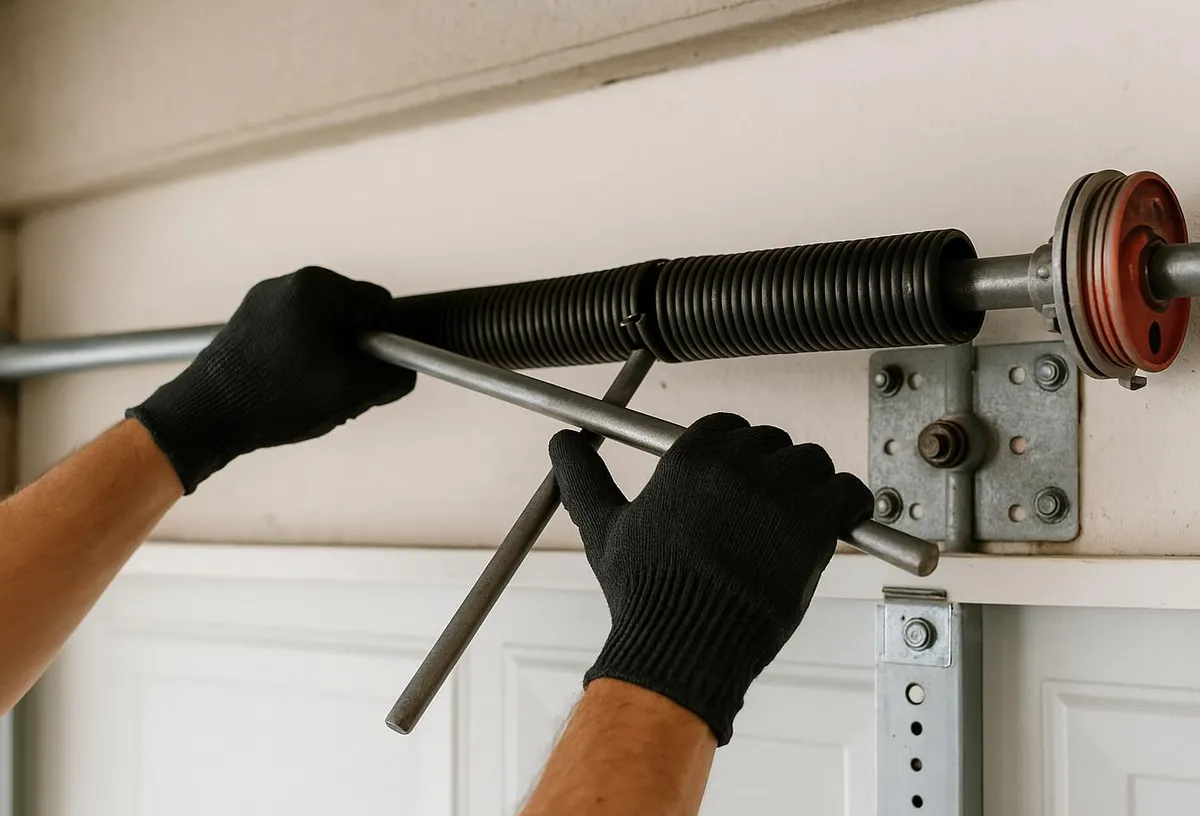
If the door feels heavy when lifted by hand, or the opener strains and groans before reversing, worn-out torsion or extension springs could be the real cause. Springs lose tension gradually with every cycle, and once they can no longer offset the door's weight, the opener has to work harder — which it interprets as an obstruction and stops. This isn't a DIY fix; springs are under high tension and require proper tools and training to replace safely.
6. Rollers, Hinges, and Track Alignment
Worn rollers or bent track sections create friction and binding that mimic an obstruction from the opener's point of view. Homes that have gone through foundation settling or earthquake retrofit work sometimes end up with a track that's shifted slightly out of plumb, even if the shift isn't visible to the eye. A technician checks the track with a level and inspects rollers and hinges for wear, replacing what's needed and re-anchoring brackets that have loosened.
7. The Opener's Logic Board
If every mechanical and sensor-related cause has been ruled out, the opener's circuit board itself may be failing — sometimes after a power surge from a storm, sometimes just from age. Boards can send inconsistent signals to the motor, causing random reversals that don't correlate with anything physical. Replacement of the board or the opener unit is usually the fix at this stage.
When to Call Precision Garage Door of Sacramento
If you've wiped the sensors, cleared the track, and the door is still reversing or refusing to close, it's time for a trained eye. Precision Garage Door of Sacramento diagnoses these issues in the order above, starting with a full safety sensor and force-setting check as part of our Garage Door Opener Repair & Installation service, and moving into spring and hardware inspection through our Garage Door Maintenance visits if the opener checks out fine. We'll tell you plainly what's causing it and what it takes to fix — no guesswork, no unnecessary parts.
If your garage door won't close or keeps reversing, call Precision Garage Door of Sacramento today and get it diagnosed and fixed right the first time.