
Short answer
Your garage door is the largest moving opening in your home's exterior wall, and in most houses it's also the weakest point. When high wind hits a closed garage door that isn't braced or rated for the load, the door can buckle or blow inward. Once that happens, wind pressure gets inside the garage and pushes up on the roof framing from underneath, which is how a wind event turns into a roof problem. Reinforcing the door before storm season is cheap insurance against a much bigger repair.
Why the garage door fails before anything else
Exterior walls with windows and solid framing are built to resist wind pressure as a connected system. A garage door is different: it's a single large panel held in place by tracks, rollers, and hinges, not by the kind of rigid framing that holds up the rest of the wall. Under sustained wind, that panel flexes. Under gusts, it flexes harder and faster. Older double-wide doors, common on many Sacramento Valley homes, have more surface area catching wind than a single door, which means more force on the same hardware.
If the panel buckles or a track pulls away from the jamb, the door can separate from its opening. Once air is moving freely through the garage, it pushes outward on the roof deck and side walls from the inside, a phenomenon that structural engineers call positive internal pressure. That's the mechanism behind a lot of storm damage that looks unrelated to the garage at first glance.
Signs your door is more vulnerable than it should be
- Single-layer steel panels with no internal reinforcement struts, common on older or builder-grade doors.
- Loose or worn tracks that already rattle or flex when the door moves.
- Wide double-car openings without a center post, which flex more than single doors of the same material.
- Stripped or missing hardware at the roller brackets and hinges, often from age or from DIY repairs with the wrong fasteners.
- Weatherstripping that's cracked or pulling away, which lets wind-driven rain push past the bottom seal and side seals during storms.
None of these are emergencies on a calm day. All of them become liabilities when wind picks up ahead of a winter storm system moving through the Central Valley.
What to check and fix before storm season
Tracks, rollers, and hardware
Walk the full length of both tracks and look for gaps where the bracket has pulled slightly away from the frame. Tighten lag screws and carriage bolts, but don't overtighten into wood that's already splitting; a stripped hole needs a larger screw or a repositioned bracket, not just more torque on a failing one.
Reinforcement struts
If your door doesn't already have horizontal reinforcement struts across the inside of the panels, this is the single most effective upgrade for wind resistance. Struts distribute wind load across the whole door instead of letting it concentrate on a few panel sections. Retrofit kits exist for many door models, and they're worth the cost on an older double-wide door well before storm season hits.
Weatherstripping and bottom seal
Replace cracked or flattened seals now, not after the first atmospheric river event floods the garage floor. A good bottom seal also reduces how much wind can get a grip under the door edge.
Opener and manual release
Know where your manual release cord is and make sure it moves freely. If the power goes out during a storm, which happens regularly in wind events, you may need to operate the door by hand. Test it before you need it, not during a blackout in the dark.
Drainage and surroundings
Check that water drains away from the garage slab rather than toward it, and trim back any tree limbs that could come down on the door during high wind. A clogged gutter or downspout dumping water at the base of the door invites both water intrusion and track corrosion.
During an actual wind event
Keep the door closed. An open or partially open garage door gives wind a direct path into the structure, which is worse than a closed door under pressure. Don't park a vehicle snug against the inside of the door; if the panel does flex or fail, you want clearance. If you get advance warning of a serious wind event and your door has known weak points, this is the moment to call for reinforcement rather than wait and see.
When to call Precision Garage Door of Sacramento
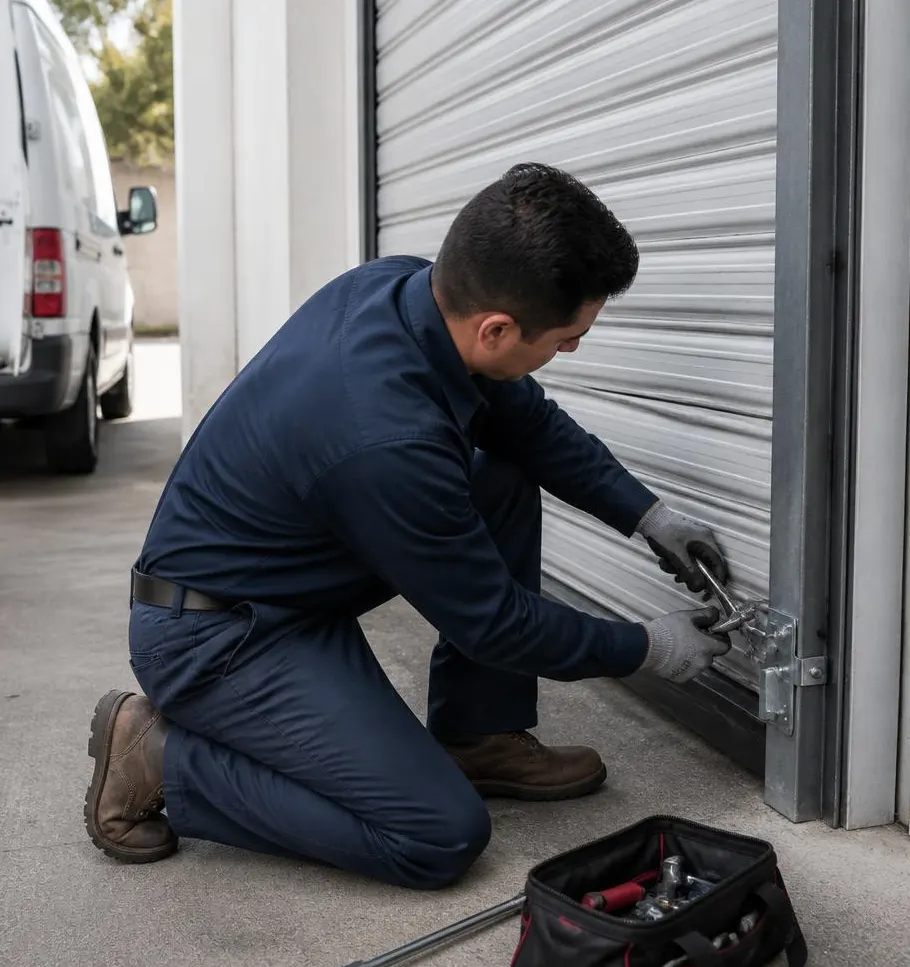
If your door flexes visibly in wind, the tracks are pulling away from the frame, or you're not sure whether your panel has reinforcement struts, that's worth a professional look before the next storm rolls through. Our technicians handle garage door maintenance to catch loose hardware, worn rollers, and failing seals before they become storm-day failures, and we handle full garage door installation for homeowners who want a heavier-duty, wind-rated door instead of patching an aging single-layer panel. We'll tell you plainly whether reinforcement is enough or whether replacement makes more sense for your specific door and opening size.
If you're in Sacramento, Elk Grove, Rancho Cordova, Citrus Heights, Folsom, Roseville, West Sacramento, or Carmichael and want your garage door checked before the next windstorm, call Precision Garage Door of Sacramento today to schedule a visit.